
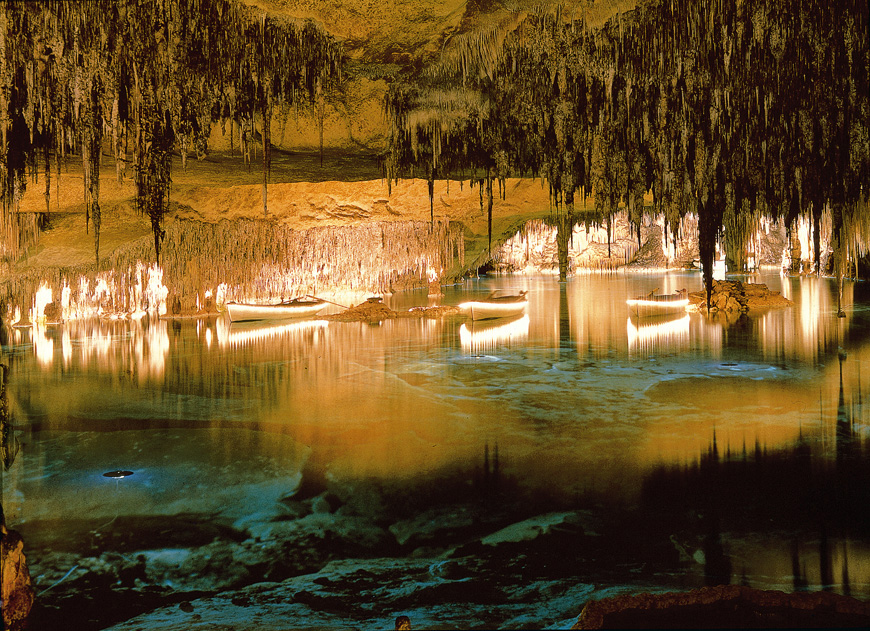
On the eastern coast of Mallorca, near the fishing village of Porto Cristo, lies one of the Mediterranean's most enchanting natural wonders. The Cuevas del Drach, or Dragon Caves, are a system of four interconnected limestone caverns extending more than 1,200 meters in length and descending to a depth of 25 meters below the surface. At their heart lies Lake Martel, one of the largest underground lakes in the world.
Historical Background
The caves were first documented in writing in 1338, during an expedition ordered by the governor of Mallorca. However, local inhabitants had known about the cave entrances for far longer. The first scientific exploration was carried out by the renowned French speleologist Edouard-Alfred Martel in 1896, who was commissioned by Archduke Ludwig Salvator of Austria to map the extensive cave system.
Martel's expedition revealed the full extent of the caves, including the discovery of the vast underground lake that now bears his name. His detailed measurements and observations laid the groundwork for the caves' development as a tourist attraction. The caves were opened to the public in the early twentieth century, and today they rank as one of the most popular visitor sites in the Balearic Islands.
The Four Caves
The Cuevas del Drach system comprises four distinct but interconnected caverns, each with its own character and geological features:
Black Cave (Cova Negra)
The first of the four caves, named for the deep darkness of its interior before electric lighting was installed. Its passages are lined with dense formations of stalactites and stalagmites in deep amber and brown tones.
White Cave (Cova Blanca)
Distinguished by its lighter-colored calcite deposits, this section features some of the most delicate formations in the system, including paper-thin curtain stalactites and pristine white flowstone pools.
Cave of Luis Salvador (Cova de Lluis Salvador)
Named after the Archduke who funded the first scientific expedition. This cave connects the outer caves with the inner chamber housing Lake Martel, and features some of the tallest columns in the system.
Cave of the French (Cova dels Francesos)
The innermost cave, accessible only through the Luis Salvador chamber. It is believed to have been partially explored by French sailors in the nineteenth century before Martel's comprehensive survey.
Lake Martel: An Underground Wonder
The highlight of any visit to Cuevas del Drach is undoubtedly Lake Martel. This subterranean body of water measures approximately 115 meters in length and 30 meters in width, with depths varying between 4 and 12 meters. The lake's crystal-clear water reflects the cave formations above, creating a mirror-like effect that doubles the visual impact of the surrounding stalactites.
What makes a visit to Lake Martel truly unique is the classical music concert that concludes every tour. As the overhead lights are dimmed to near darkness, small illuminated boats carrying musicians appear on the water. The ensemble performs short pieces of classical music, with the natural acoustics of the cave amplifying and enriching the sound in ways impossible to replicate in any concert hall. Visitors can then take a short boat ride across the lake at the end of the performance.
 Dramatic formations line the pathways of the Dragon Caves. Photo: Wikimedia Commons (CC BY-SA 4.0)
Geology of the Caves
The Cuevas del Drach were formed through a process known as karstification, in which slightly acidic rainwater gradually dissolved the Miocene-era limestone bedrock of eastern Mallorca. Over millions of years, this process carved out an extensive network of passages and chambers, with water seeping through cracks in the rock and slowly enlarging them into the cavernous spaces visitors see today.
The close proximity of the caves to the Mediterranean Sea means that the water level inside Lake Martel fluctuates with the tides, confirming a subterranean connection to the ocean. The water in the lake is a mixture of fresh groundwater and seawater, creating a slightly brackish environment. The temperature of the water remains constant at approximately 17 degrees Celsius throughout the year.
Visitor Information
| Location | Ctra. de les Coves, s/n, 07680 Porto Cristo, Mallorca |
| Opening Hours | 10:30 AM - 5:00 PM (varies seasonally) |
| Tour Duration | Approximately 1 hour (including concert) |
| Temperature Inside | Constant 21 degrees Celsius |
| Route Length | Approximately 1,200 meters |
| Accessibility | Well-maintained pathways; some steps at entrance |
How to Get There
Porto Cristo is located approximately 65 kilometers east of Palma de Mallorca. The caves can be reached by car via the Ma-4020 road, with ample parking available at the site. Regular bus services also operate from Palma, Manacor, and other towns across the island. Many hotels and tour operators in Mallorca offer day trips that include transport to and from the caves.
Practical Tips
Arrive at least 30 minutes before your scheduled tour time, as tours depart at fixed intervals and late arrivals cannot be accommodated. The walk from the parking area to the cave entrance takes about 10 minutes along a landscaped path. Bring a light sweater, as the temperature inside is considerably cooler than the Mallorcan heat outside. Photography without flash is permitted throughout most of the cave.